Journeyman Electrician Study Guide: A Comprehensive Plan

Embark on a focused journey! This guide prioritizes code navigation over memorization, utilizing the ‘Wave Method’ for efficient exam tackling and success.
Preparing for the Journeyman Electrician exam requires a strategic approach, shifting focus from rote memorization of the National Electrical Code (NEC) to proficient code navigation. Many candidates mistakenly believe success hinges on knowing the NEC by heart, but the exam primarily tests your ability to locate and apply relevant information quickly and accurately.
This exam assesses practical knowledge and problem-solving skills, demanding a solid understanding of electrical theory, calculations, and NEC regulations. Mastering the ‘Wave Method’ – a time management and question prioritization technique – is crucial. Effective preparation involves consistent practice with timed tests, simulating exam conditions, and familiarizing yourself with the code book’s index to expedite information retrieval. Remember, speed and accuracy are paramount!
II. Understanding the National Electrical Code (NEC)
The National Electrical Code (NEC) is the cornerstone of electrical safety in the United States, establishing consistent standards for electrical installations. However, attempting to memorize the entire NEC is impractical and ineffective for the Journeyman exam. Instead, focus on understanding its structure, organization, and how to efficiently locate specific information.
The NEC is divided into Articles, each covering a specific aspect of electrical work. Familiarize yourself with the commonly referenced Articles – 250 (Grounding & Bonding), 300-368 (Wiring Methods), and 430 (Motors). Developing a strong grasp of the NEC’s scope and limitations is vital. Practice using the index to quickly pinpoint relevant sections, a skill essential for successful exam performance.
III. Essential NEC Chapters for the Exam
Certain NEC chapters appear more frequently on the Journeyman Electrician exam than others. Prioritize your study efforts on these key areas for maximum impact. Chapter 1: General provides foundational rules and definitions. Chapter 2: Wiring Methods details acceptable installation techniques. Chapter 3: Wiring Materials covers conductor types and their applications.
Chapter 4: Equipment for General Use addresses the installation of various electrical devices. Chapter 8: Communications Systems is increasingly relevant with evolving technology. Chapter 9: Tables is crucial – mastering these tables saves significant exam time. Focus on understanding the ‘why’ behind the rules, not just memorizing them, to navigate complex scenarios effectively.
A. Chapter 1: General
NEC Chapter 1 establishes the fundamental principles and scope of the National Electrical Code. It defines key terms, outlines the board’s authority, and clarifies the Code’s applicability. Understanding Article 100, defining terms, is paramount. Pay close attention to rules governing enforcement and the responsibilities of those involved in electrical installations.
This chapter isn’t heavily tested with direct recall questions, but its concepts underpin many other Code requirements. A solid grasp of Chapter 1 provides context for interpreting more complex rules. Familiarize yourself with the limitations and exceptions outlined within, as these often appear in exam scenarios. It’s a foundational building block for code comprehension.
B. Chapter 2: Wiring Methods
Chapter 2 details acceptable methods for installing electrical conductors and equipment. It covers various wiring methods like conduit, cable, and surface raceways, outlining specific requirements for each. Understanding permitted combinations and limitations is crucial for exam success. Focus on the rules governing conductor installation in different environments and the proper use of supports and securing devices.
Pay close attention to the sections on wiring in hazardous locations, as these often appear as exam questions. Familiarize yourself with the different cable types (NM, THHN, etc.) and their appropriate applications. Chapter 2 is heavily tested, so thorough study is essential for navigating related exam scenarios effectively.
C. Chapter 3: Wiring Materials
Chapter 3 focuses on the characteristics and uses of various wiring materials. This includes conductors, insulation, and other components used in electrical installations. Understanding conductor ampacity, temperature ratings, and allowable voltage drop is vital for accurate calculations and safe installations. Pay close attention to the different types of conductors – copper, aluminum, and their alloys – and their specific applications.

The chapter also covers cable assemblies and their markings, which are frequently tested on the journeyman exam. Familiarize yourself with the NEC tables detailing conductor properties and insulation types. Mastering this chapter will equip you to confidently answer questions related to material selection and proper usage.
D. Chapter 4: Equipment for General Use
Chapter 4 delves into the requirements for various electrical equipment, encompassing everything from receptacles and switches to lighting fixtures and appliances. A key focus is understanding the proper installation and protection of this equipment, adhering strictly to NEC guidelines. Pay particular attention to device ratings, mounting heights, and spacing requirements.

This chapter frequently tests knowledge of Ground Fault Circuit Interrupters (GFCIs) and Arc Fault Circuit Interrupters (AFCIs), their applications, and where they are mandated by code. Familiarize yourself with the specific requirements for different occupancies and equipment types. Mastering Chapter 4 ensures you can confidently address equipment-related questions on the exam.
E. Chapter 8: Communications Systems
Chapter 8 focuses on the installation of communications circuits, including telephone, telegraph, alarm, and data systems. While not always a primary focus, understanding the requirements for these systems is crucial, particularly concerning limited power sources and separation from electrical wiring.
Pay close attention to the rules regarding bonding and grounding of communications systems, as well as the permissible wiring methods. The NEC outlines specific requirements to prevent interference and ensure safety. Expect questions related to the installation of low-voltage wiring and the protection of these circuits. Thorough preparation in this area will broaden your exam readiness.
F. Chapter 9: Tables
Chapter 9 is arguably the most vital section for exam success. It contains essential tables for conductor ampacities, voltage drop, conduit fill, and motor information. Mastering the location and application of these tables is paramount, as the exam heavily relies on quick referencing.
Practice using the tables extensively during your study sessions. Don’t just memorize values; understand how to find the correct information efficiently. The ‘Wave Method’ emphasizes rapid code navigation, and Chapter 9 is where this skill is most critical. Bookmark frequently used tables or create a personal index for swift access during the exam.
IV. Key Exam Topics: Electrical Theory & Calculations
A solid grasp of electrical theory is fundamental. Focus on Ohm’s Law (V=IR), power calculations (P=VI), and understanding series and parallel circuits. Three-phase power calculations are also frequently tested, so dedicate ample study time to these concepts.
Motor calculations, including horsepower (HP) and full-load amps (FLA), are crucial. Be prepared to calculate conductor sizes and overcurrent protection based on motor specifications. The ‘Wave Method’ suggests tackling these calculations during the fourth wave, after initial code navigation. Practice consistently to build speed and accuracy in these essential areas.
A. Ohm’s Law and Power Calculations
Mastering Ohm’s Law (V=IR) is paramount; voltage, current, and resistance are interconnected. Understand how changes in one affect the others; Power calculations (P=VI, P=I²R, P=V²/R) are equally vital, enabling you to determine power consumption and efficiency.
Practice applying these formulas to various circuit scenarios. Expect questions involving series and parallel circuits, requiring you to calculate total resistance, current, and voltage drops. During the exam, utilize the ‘Wave Method’ to quickly address these calculations in later stages, after initial code-based questions. Accuracy and speed are key!

B. Series and Parallel Circuits
Grasp the fundamental differences between series and parallel circuits. In series, components share the same current, while voltage divides. Conversely, parallel circuits maintain constant voltage, with current dividing among branches. Calculating total resistance differs significantly for each configuration.
Expect exam questions requiring you to analyze these circuits. You’ll need to determine voltage drops, current flow, and power dissipation in each component. Remember to apply Ohm’s Law and power formulas effectively. During the exam’s later waves, tackle these calculations efficiently, leveraging your foundational knowledge.
C. Three-Phase Power Calculations

Master three-phase power calculations, a crucial exam component. Understand the relationship between voltage, current, power factor, and power in three-phase systems. Be prepared to calculate apparent power (kVA), true power (kW), and reactive power (kVAR). Familiarize yourself with both wye (star) and delta configurations.
Expect questions involving motor loads and transformer calculations. You’ll need to determine current draw, voltage imbalances, and power requirements. During Wave 3 & 4, efficiently navigate the NEC to find relevant formulas and tables. Practice these calculations extensively to build speed and accuracy for exam success.
D. Motor Calculations (HP, FLA, etc.)
Motor calculations are frequently tested; proficiency is essential. Focus on converting horsepower (HP) to full-load amps (FLA) using tables in Chapter 9 of the NEC. Understand motor efficiency and how it impacts current draw. Be prepared to calculate conductor ampacity and overload protection sizes based on motor FLA.
Practice calculating locked-rotor amps (LRA) and their implications for short-circuit current calculations. During Wave 4, quickly locate the necessary tables for these calculations. Remember to consider motor temperature ratings and applicable derating factors. Mastering these concepts will significantly boost your exam score.

V. Grounding and Bonding (Article 250)
Article 250 is a cornerstone of the Journeyman exam; dedicate significant study time here. Understand the difference between system grounding and equipment grounding, and their respective purposes in fault current paths. Familiarize yourself with bonding requirements for various metallic components, ensuring electrical safety.
Master the rules for grounding electrodes, including water pipes, ground rods, and concrete-encased ducts. During the exam, quickly reference Article 250 using your page markers. Know how to calculate grounding electrode conductor sizes and bonding jumper sizes. A solid grasp of these concepts is crucial for success.
A. System Grounding
System grounding establishes a low-impedance path back to the source, crucial for overcurrent device operation and voltage stabilization. Understand the different types of system grounding – solidly grounded, impedance grounded, and ungrounded – and their applications. Know the requirements for the grounding electrode system, including the connection to earth.
Focus on identifying acceptable grounding electrodes and calculating the size of the grounding electrode conductor. Be prepared to analyze scenarios involving multiple grounding electrodes bonded together. During the exam, quickly locate relevant sections within Article 250 for specific grounding requirements. A firm understanding of system grounding is fundamental.
B. Equipment Grounding
Equipment grounding provides a fault current path, tripping the overcurrent protection device and minimizing shock hazard. It’s distinct from system grounding, focusing on metallic enclosures and non-current-carrying parts. Master the rules for bonding metal conduit, metal boxes, and equipment enclosures to the grounding system.
Pay close attention to the requirements for grounding receptacles and equipment with cord-and-plug connections. Understand the use of equipment grounding conductors (EGCs) and their proper sizing. During the exam, quickly reference Article 250 for specific equipment grounding scenarios. Efficient code navigation is key to success on these questions.
C. Bonding Requirements
Bonding establishes electrical continuity, creating a low-impedance path for fault currents. This is crucial for ensuring the effectiveness of the grounding system and minimizing potential differences between metallic objects. Understand the difference between bonding and grounding – they work together for safety.
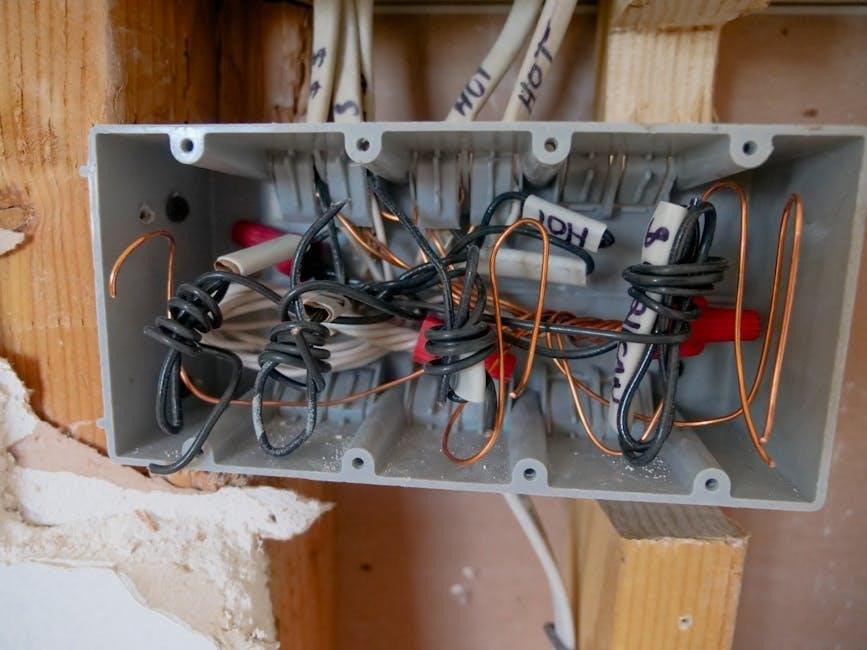
Focus on bonding metallic water pipes, gas pipes, and structural steel. Know when bonding jumpers are required and how to size them correctly. Article 250 details specific bonding requirements for various situations. Practice locating these rules quickly using the index of the NEC during your study sessions. Remember, efficient code navigation is paramount!
VI. Overcurrent Protection (OCPD)
Overcurrent Protective Devices (OCPDs) safeguard conductors and equipment from damage due to excessive current. Mastering OCPD selection and application is vital for exam success. Circuit breakers and fuses are the primary types, each with unique characteristics and applications.
Focus on understanding ampacity, conductor termination temperatures, and the various correction and adjustment factors. Practice calculating proper OCPD sizing for different loads and wiring methods. Don’t memorize every rule; instead, learn how to find the relevant information quickly within the NEC. Prioritize Article 240 for detailed OCPD requirements.
A. Circuit Breakers and Fuses
Circuit breakers and fuses are essential OCPDs, interrupting current flow during overloads or short circuits. Breakers are reusable, while fuses require replacement after operation. Understanding their distinct characteristics is crucial.
Focus on inverse-time and time-delay characteristics, as these impact coordination and application. Learn to differentiate between various fuse types (e;g., time-delay, fast-acting) and breaker trip curves. The NEC outlines specific requirements for their application based on load type and system voltage. Practice identifying appropriate devices for different scenarios, referencing NEC Article 240 for detailed guidance and application rules.
B. Overcurrent Protection Sizing
Accurate overcurrent protection device (OCPD) sizing is paramount for safety and code compliance. This involves determining the correct ampacity based on conductor size, termination temperature, and application. NEC tables (like 310.16) provide ampacity values for various conductors.
Standard calculations involve applying correction and adjustment factors for ambient temperature, conduit fill, and motor loads. Motor calculations require considering full-load amps (FLA) and applying appropriate multipliers. Understanding the 125% rule for continuous loads is vital. Master these calculations, referencing NEC Article 240, to confidently select appropriately sized breakers and fuses, ensuring both protection and operational reliability.
VII. Wiring Methods and Materials (Articles 300-368)
Mastering wiring methods is crucial; this section covers conduit fill calculations, determining the maximum number of conductors allowed within a specific conduit size (NEC Chapter 9 tables are key!). Familiarize yourself with various cable types – NM-B, THHN, THWN – and their appropriate applications based on environment and installation requirements.
Understand the rules governing wiring in different occupancies and the proper support and securing of conductors. Pay close attention to box fill calculations, ensuring adequate space for conductors and devices. Thorough knowledge of Articles 300-368 will equip you to confidently navigate real-world installation scenarios.
A. Conduit Fill Calculations
Conduit fill is a frequently tested area; accurately determining the permissible number of conductors within a conduit is essential for safety and code compliance. Utilize NEC Chapter 9, Tables 4 and 5, to find the appropriate fill percentages based on conduit type and conductor size.
Remember to account for conductor insulation types (THHN, THWN, etc.) as they impact overall conductor diameter. Practice calculating cross-sectional areas and applying the appropriate derating factors when multiple conductors are present. Mastering these calculations will significantly improve your exam performance and practical skills.
B. Cable Types and Applications (NM, THHN, etc.)
Understanding cable applications is crucial; NM cable (Romex) is common in dry, interior locations, while THHN/THWN conductors require conduit for protection. Know the temperature ratings and allowable uses for each cable type as defined by the NEC.
Pay close attention to wet locations and the appropriate cable types needed for those environments. Familiarize yourself with the differences between various conductor insulation types and their respective ampacity ratings. Correct cable selection ensures safety and adherence to code regulations, a key exam focus.
VIII. Exam Taking Strategies: The Wave Method
Master the ‘Wave Method’ for optimal time management! Wave 1 involves quickly answering known questions (3-5 seconds each). Wave 2 allows 30 seconds per question, still avoiding the code book. Waves 3 & 4 utilize the NEC – 1-2 minutes, then 3-5 minutes per question, respectively.
Prioritize! Aim for 70-85% completion by Wave 4, tackling easier calculations then. Wave 5 addresses the most challenging questions. Use scrap paper for page markers (Articles 250, 300, 430, Chapter 9) and practice navigating a code book without tabs. Dedication to timing is paramount for success.
A. Wave 1: Quick Wins
Initiate Wave 1 with a rapid scan of the entire exam. Your objective is to immediately answer all questions you know confidently, without prolonged thought. Limit yourself to a strict 3-5 second consideration per question. This initial wave focuses on capitalizing on readily accessible knowledge.
Avoid getting bogged down! If a question requires calculation or code research, bypass it entirely. The goal isn’t accuracy at this stage, but speed and momentum. This quick pass builds confidence and identifies low-hanging fruit, maximizing efficiency before tackling more complex problems.
B. Wave 2: Moderate Difficulty
Following Wave 1, commence Wave 2 with another full exam sweep. This time, allocate up to 30 seconds per question, revisiting those initially skipped. Still, resist the urge to consult the National Electrical Code (NEC). Focus on questions where the answer feels within reach, requiring a bit more consideration but not extensive research.
Prioritize recall and application of learned concepts. This wave tests your foundational understanding. If a question remains unclear after 30 seconds, move on. The aim is to solidify answers you’re reasonably certain about, building a stronger base before diving into code book navigation.
C. Wave 3 & 4: Code Book Navigation
Waves 3 and 4 are where NEC proficiency shines. In Wave 3, dedicate a maximum of 1-2 minutes per question, actively utilizing the code book. Employ your pre-prepared page markers (Articles 250, 300, 430, Chapter 9) and the index to swiftly locate relevant information. Speed and accuracy are crucial.
Wave 4 extends this timeframe to 3-5 minutes per question. Tackle more complex scenarios, recognizing that 70-85% of the exam should now be addressed. Focus on calculations – conductor and conduit sizing, motor calculations – where code application is direct. Efficient code navigation is paramount for success.
D. Wave 5: Challenging Questions
Wave 5 is for the remaining, most difficult questions. Prioritize them based on perceived difficulty, tackling the less daunting first. This final wave often presents residential scenarios – single and multi-family dwellings – demanding thorough code application. Don’t hesitate to revisit earlier questions if clarity emerges during this phase.
Remember, even if unable to answer every question definitively, a strategic approach maximizes points. Utilize all remaining time wisely, focusing on educated guesses rather than leaving answers blank. Persistence and a systematic review are key to optimizing your score and achieving journeyman certification.
IX. Practice Resources and Exam Preparation
Maximize your preparedness with dedicated practice! The Mike Holt website offers invaluable timed tests, simulating the exam environment. Consistent practice is crucial, especially navigating the NEC without tabs – honing your indexing skills. Familiarize yourself with common articles like 250, 300, and 430, creating mental bookmarks for rapid access.
Simulate test conditions rigorously, including time constraints and code book access (or lack thereof). This builds confidence and refines your ‘Wave Method’ execution. Remember, success hinges on efficient code navigation, not rote memorization. Invest time in practice; it’s the cornerstone of passing your journeyman exam.